
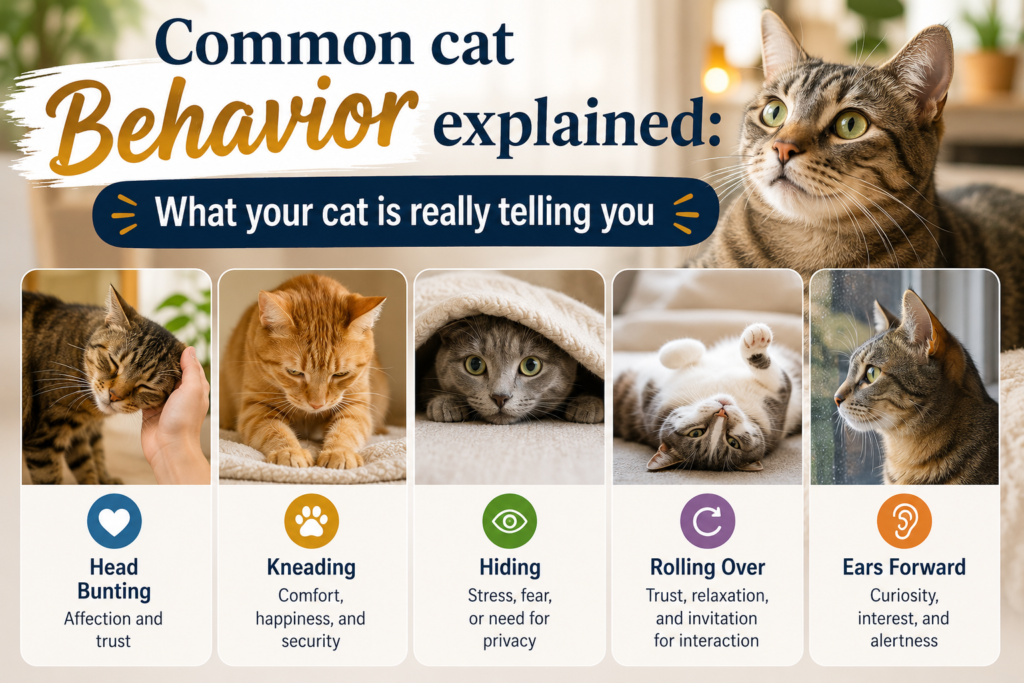
Cats have a reputation for being mysterious, aloof, and impossible to read. Unlike dogs, who often wear their hearts on their sleeves, cats communicate through a complex, subtle language of vocalizations, body postures, and quirky habits. If you have ever wondered why your cat suddenly sprints across the room at 3 AM or what a twitching tail actually means, you are not alone.
Understanding feline behavior is the key to building a stronger, more trusting bond with your pet. This comprehensive guide decodes common cat behaviors so you can finally understand exactly what your cat is really telling you.
1. Vocalizations: The Language of Meows, Purrs, and Chirps
While body language is their primary mode of communication with other felines, cats have developed a specific set of vocalizations almost entirely to communicate with humans.
Meowing
Adult cats rarely meow at other cats; they reserve this sound for you. A meow is a multi-purpose tool. A short, high-pitched meow is usually a greeting. A drawn-out, demanding meow often means they are hungry or want a door opened. If your cat is meowing excessively, they may be seeking attention or, in older cats, experiencing cognitive decline or discomfort.
Purring
Most people associate purring with a happy, relaxed cat. While this is often true—especially if they are curled up in your lap—cats also purr when they are stressed, in pain, or frightened. Purring releases endorphins and operates at a frequency (between 25 and 150 Hertz) that has been shown to promote tissue regeneration and bone healing. Think of it as a cat’s built-in self-soothing mechanism.