How Compound Interest Works, With Simple Examples
Compound interest means earning interest on your interest. It can grow savings and inflate debt. See how it works, why time matters and how to estimate it yourself.
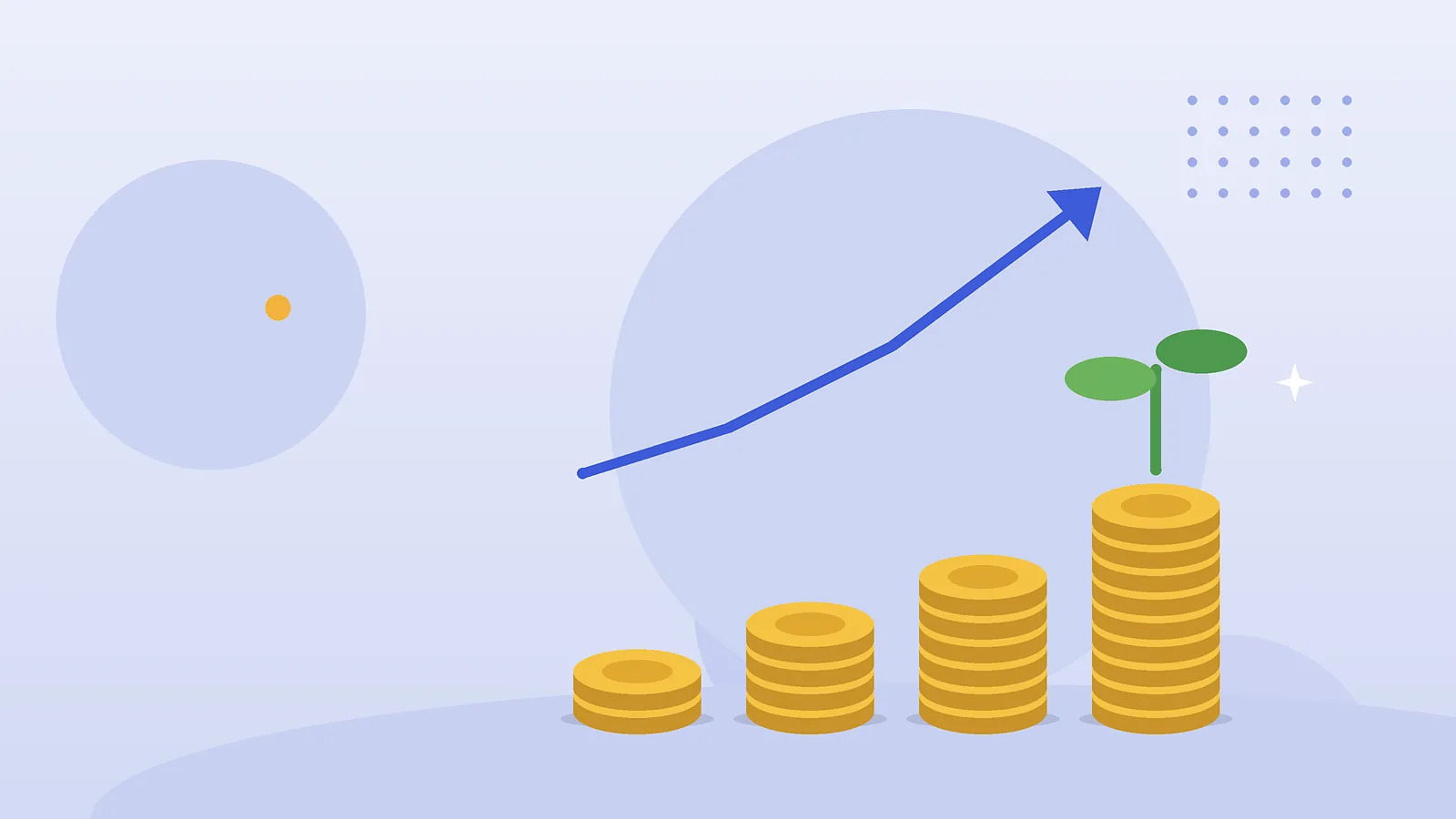
Compound interest is interest calculated on both your original amount (the principal) and the interest already added. Over time, that snowball effect can make savings grow faster. It also explains why unpaid credit card balances can grow so quickly.
Simple vs compound interest
Imagine depositing $1,000 at a 5% annual rate:
- Simple interest pays 5% on the original $1,000 only, which is $50 every year. After 10 years you would have $1,500.
- Compound interest, compounded yearly, pays 5% on the growing balance. Year one earns $50, year two earns $52.50 on $1,050, and so on. After 10 years you would have about $1,629.
The gap widens over longer periods, because each year's interest earns interest of its own.
The formula
A = P × (1 + r/n)n × t
- A is the final amount
- P is the principal (starting amount)
- r is the annual interest rate as a decimal (5% = 0.05)
- n is the number of times interest compounds per year
- t is the number of years
You do not need to do this by hand. The U.S. SEC's free Investor.gov compound interest calculator lets you try different amounts, rates, time periods and monthly contributions.
Why time matters so much
| Years at 5% (compounded yearly) | $1,000 grows to about |
|---|---|
| 10 | $1,629 |
| 20 | $2,653 |
| 30 | $4,322 |
These are illustrative calculations with a fixed rate. Real savings rates change, and investment returns are not fixed or guaranteed. Investments can lose value, and past performance does not predict future results.
The rule of 72
For a quick estimate of how long money takes to double, divide 72 by the annual interest rate. At 6%, money doubles in roughly 72 ÷ 6 = 12 years. It is an approximation that works best for moderate rates.
Compounding frequency, APR and APY
- Interest can compound yearly, monthly or daily. More frequent compounding produces slightly more growth at the same stated rate.
- APY (annual percentage yield) on savings accounts includes the effect of compounding, so it is useful for comparing savings products.
- APR (annual percentage rate) on loans and credit cards usually describes the yearly cost of borrowing. Card interest is often calculated daily on your balance.
When compound interest works against you
Unpaid credit card balances accrue interest, and that interest is added to the balance, which then accrues more interest. Paying more than the minimum reduces the amount on which future interest is charged. Our guide to paying off credit card debt explains the main strategies.
Putting it to work
- Start saving early, even small amounts. Time is the biggest factor in compounding.
- Contribute regularly, ideally automatically.
- Compare APYs and fees on savings accounts, and keep emergency money somewhere safe and accessible. See how to build an emergency fund.
- Before investing, learn the basics of risk, diversification and fees, and consider speaking with a qualified, independent financial professional about your situation.